Eco-solvent Ink for OPP, PVC, and PET Films: What Printers Need to Know
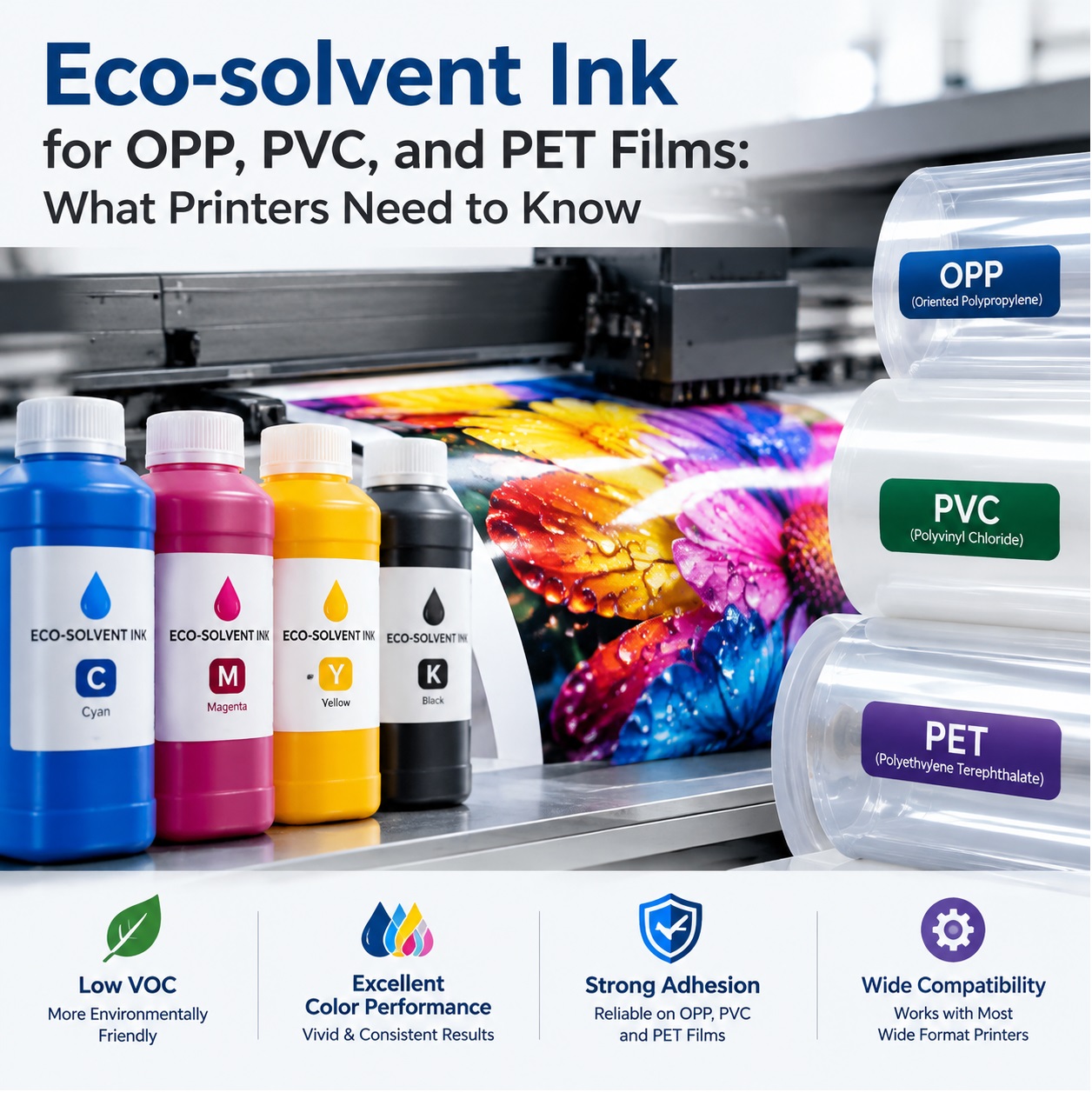 Walk into any print shop that runs roll-to-roll and you’ll hear the same quiet confession: the machine is rarely the problem. The ink and the film are where money gets made or quietly lost. Eco-solvent has become the default choice for a huge chunk of flexible film work, but “eco-solvent compatible” on a spec sheet tells you almost nothing about whether your OPP job will survive a chill test or whether your PET banner will still look sharp after a season outdoors.
Let’s cut through the marketing gloss and talk about what actually matters on the floor.
Why Eco-Solvent Still Earns Its Place
Eco-solvent sits in a useful middle ground. It’s gentler than full solvent, which means fewer headaches with operator safety, less aggressive odor, and a lighter touch on heat-sensitive substrates. It also cures well at lower temperatures than many latex or UV alternatives, and it plays nicely with a wide range of films. The trade-off is real: durability isn’t infinite, and you can’t treat it like a solvent tank that shrugs off anything you throw at it. The key is matching the ink to the film instead of hoping the film bends to the ink.
OPP Film: The Sensitive One
Oriented polypropylene is thin, slick, and deceptively demanding. It’s cheap, it’s everywhere, and it will punish you if you skip prep. The surface energy on untreated OPP is low, which means eco-solvent ink has a hard time gripping. If you print without a primer or a corona treatment, you’ll get beading, patchy coverage, and edges that flake off the moment the film flexes.
Two practical fixes dominate. First, corona treatment right before printing, because the effect fades within days and a roll sitting in the warehouse loses its edge. Second, a proper primer coat if your workflow allows it. OPP also hates heat, so dial back your platen temperature and let the ink dry through airflow rather than baking. Run a tape test and a crease test on every new batch, not just the first one. Suppliers change formulations without telling you.
PVC Film: The Reliable Workhorse
If there’s a substrate that was practically built for eco-solvent, it’s PVC. Self-adhesive vinyl, banner material, vehicle wrap film, backlit panels, the list goes on. Adhesion is generally strong, color vibrancy is excellent, and the film stretches and conforms in ways that make installers happy.
But PVC has a dirty secret: plasticizers. Cheap vinyl bleeds them over time, and that migration can cause ink to yellow, crack, or delaminate. If you’re printing wraps or anything with a long outdoor life, you want a film with a reputation for plasticizer resistance, and you want to laminate. Eco-solvent ink on unlaminated PVC will fade faster than most clients expect, especially in high-UV regions. Also watch your drying. PVC can trap solvent if you stack prints too soon, which leads to ghosting and blocked images. Give them air, give them time.
PET Film: The Precision Player
Polyester film is where eco-solvent gets interesting. PET is dimensionally stable, tough, and holds detail beautifully, which is why it shows up in labels, backlit displays, membrane switch overlays, and industrial graphics. It’s also less forgiving of a sloppy setup.
PET has decent surface energy, but its smooth, non-porous face means ink sits on top rather than soaking in. That makes adhesion and scratch resistance a genuine concern. A primer or a topcoat is often the difference between a print that lasts and a print that scuffs off in handling. PET also tends to need slightly higher drying attention because there’s no absorption at all. And because PET is often used in precise applications, you can’t get away with loose tension or a wobbly profile. Registration errors show up immediately.
The Cost Conversation Nobody Wants to Have
Eco-solvent ink looks cheap per liter. The expensive part is everything around it: ruined rolls from poor adhesion, reprints, customer returns, and the labor spent troubleshooting. A $40 primer that saves a $400 roll is not a cost, it’s insurance. Printers who treat media profiling as a one-time setup task tend to bleed money quietly for years. Every new film, every new ink batch, every seasonal humidity swing can shift how the chemistry behaves. Build a small test protocol and actually use it.
What to Check Before You Commit
Ask three questions about any film you’re considering. How does it behave after 24 hours, not 24 minutes? What happens under a fingernail scratch and a stretch? And how does it hold up after lamination or a week in the sun? If the supplier can’t answer with data, test it yourself. Sample rolls exist for a reason.
A few habits separate shops that rarely have problems from shops that always do. Store film in controlled conditions, because heat and humidity change surface behavior. Keep your printheads clean and your profiles current. Don’t mix ink brands casually; chemistry is not universal. And document what works, because institutional memory beats tribal knowledge every time.
The Bottom Line
Eco-solvent ink is not a miracle worker, and it’s not a compromise either. It’s a system, and OPP, PVC, and PET each demand their own version of that system. OPP rewards prep. PVC rewards patience and the right formulation. PET rewards precision. Get those three right and you’ll spend a lot less time reprinting and a lot more time taking on work your competitors turn down.