Paste Backfill: How to Choose the Right Pipeline System for Underground Mining
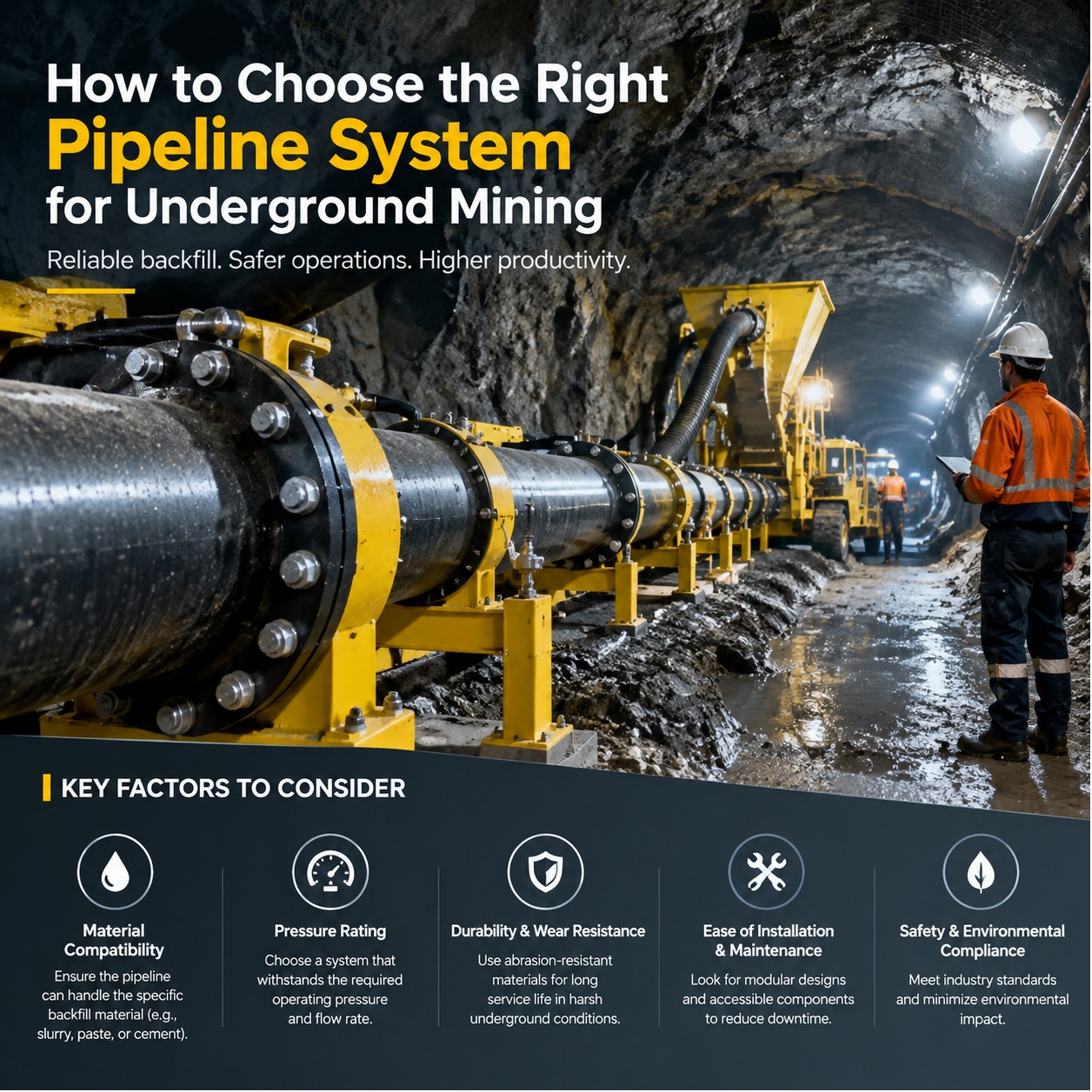
Two years into a paste plant upgrade, a mine in the Goldfields was swapping out elbows every eleven weeks. The pipe body was fine. The problem had been locked in eighteen months earlier at a desk, by people comparing dollars per metre instead of dollars per tonne placed. That is the whole game with paste backfill pipelines. The steel is the easy part. The engineering wrapped around it is where the money is made or quietly bled away.
So let’s skip the brochure language and talk about how a pipeline system actually gets chosen.
START WITH THE PASTE, NOT THE PIPE
Nobody can size a pipeline until they know what is going through it. Paste is not a generic fluid. It is a non-Newtonian slurry with a yield stress, and those two numbers, yield stress and plastic viscosity, drive everything downstream.
If your plant is pushing 78 to 82 percent solids with a yield stress north of 200 Pa, you are dealing with something closer to a moving solid than a liquid. If you are running a lower-density fill at 70 percent solids, the behaviour changes completely. Particle size distribution matters too. A tailings stream with a top size of 2 mm and a heavy coarse fraction will wear a pipe very differently than a fine, slimes-dominated stream, even at the same density.
Get a proper rheology program done on your actual tailings, at your actual mix ratios, across the range of temperatures you will see. Not a bench test on a synthetic sample. Real material, real binder, real curing times. Everything after this point is guesswork without it.
THE VELOCITY WINDOW IS NARROWER THAN YOU THINK
There is a band of pipeline velocity where paste behaves. Go below it and you get settlement, bedding on the invert, and eventually a plugged line at 3 a.m. on a Sunday. Go above it and you convert your pipe into a grinding mill, and abrasion rates climb with roughly the cube of velocity in the bend-heavy sections.
For most paste systems that window sits somewhere between about 1.0 and 2.0 metres per second, and the exact target depends on your rheology and your coarse fraction. The trick is that velocity is a function of flow rate and diameter. You do not choose them independently. You choose the tonnage you need to place per hour, then you find the diameter that puts you in the window, then you check what that diameter does to your pressure profile.
This is where a lot of projects go wrong. Someone picks a pipe size because it matches the existing surface line, or because it was available, and then spends the next decade fighting it.
DIAMETER IS A PRESSURE DECISION
Bigger pipe means lower friction loss per metre, which sounds like a win until you realise that to keep velocity up in a larger bore you need more flow, and if you do not have more flow, you drop out of the window and the line sands up.
Smaller pipe gives you velocity cheaply but punishes you with head loss. On a long surface-to-underground route, that head loss can force you into a much larger pump package, or a booster station, or a borehole you did not plan for.
Run the numbers across at least three diameters. Look at the whole route, not just the horizontal runs. Vertical drops, inclines, tight radius bends, and the transition from surface borehole to level drift all carry their own losses. A pipeline that looks comfortable on the flat can be marginal the moment it turns vertical.
VERTICAL DROPS DESERVE RESPECT
Free-falling paste down a deep borehole is not the same as pumping it. The column accelerates, pressure at the bottom is governed by the head, and if you get the design wrong you can generate vacuum conditions, air entrainment, and slugging that hammers the entire system.
You need to know the maximum static head, the required back pressure to keep the column stable, and whether you are relying on gravity, a pump, or a combination. Air release and breakaway arrangements are not optional extras. Neither is a proper analysis of what happens during a shutdown, when the column is sitting there and the paste starts to develop its gel strength.
If your borehole is going to be lined, decide that early. Retrofitting a liner into a hole that has already been drilled is an expensive conversation.
MATERIAL SELECTION IS A WEAR QUESTION, NOT A PRICE QUESTION
The options generally come down to plain carbon steel, wear-resistant alloy steel, HDPE-lined steel, rubber-lined steel, and ceramic or basalt-lined pipe. Each has a place.
Plain steel is fine for straight runs of fine, low-abrasion paste. It is a poor choice for a bend carrying coarse tailings. HDPE-lined steel gives you good abrasion resistance and a low friction factor, which can reduce your pumping pressure, but the liner has a temperature ceiling and it does not enjoy sharp bends or rough handling. Rubber-lined pipe handles impact and coarse particles well but adds wall thickness and weight. Ceramic-lined sections are superb in high-wear locations and expensive everywhere else.
The sensible approach is a hybrid. Use the premium wear material where the wear actually happens, and plain or lined steel where it does not. That usually means the first few bends off the borehole, any direction change, and the discharge area. It almost never means lining the entire route.
BENDS, JOINTS, AND THE THINGS THAT FAIL FIRST
Straight pipe rarely fails. Bends fail. Transitions fail. Flange faces and gasket seats fail. Plan your route to minimise direction changes, use long radius bends wherever the geometry allows, and avoid back-to-back bends that concentrate wear on one spot.
For joints, flanged connections give you the easiest rotation and replacement. Grooved couplings are faster to install but less forgiving under high pressure. Welded joints reduce leak paths but make maintenance miserable. Whatever you choose, make sure the same system is used throughout so your spares strategy stays simple.
Then build a rotation program. Measure wall thickness on a schedule. Ultrasonics on a new pipe gives you a baseline, and repeat readings tell you exactly how fast you are consuming the steel. Mines that track this replace pipe on a plan. Mines that do not replace pipe on a breakdown.
THE QUESTIONS WORTH ASKING BEFORE YOU SIGN
Ask any supplier these, and watch how they answer.
What is the design pressure and what safety factor sits behind it?
How was the friction loss calculated, and against what rheology data?
What velocity range does this system hold, and what happens at turndown?
How does the design handle a full shutdown with the line charged?
What is the expected wear life in the bends, and what is it based on?
What does commissioning look like, and who is on site for it?
Can you provide references on comparable paste duty, not just comparable pipe size?
A supplier who can answer all of that without disappearing into a spreadsheet is a supplier who has done this before. One who cannot is selling you metres of pipe and hoping.
THE COST THAT ACTUALLY MATTERS
Purchase price is the smallest number in the equation. Total cost of ownership includes installation, pumping energy, wear replacement, downtime, flushing and cleaning, and the labour attached to all of it. A line that costs 30 percent more upfront and lasts three times as long in the high-wear sections is not a premium purchase. It is the cheaper one.
Paste backfill pipelines are not a commodity. They are a designed system, and the design work is what determines whether you are replacing elbows every eleven weeks or every three years. Choose the people who do the engineering, not just the people who stock the pipe.